
Siemens
Strategic Investment in Emerald AI
As AI drives unprecedented demand for data center capacity, the industry faces the growing challenge of balancing rapidly expanding computing infrastructure with available power. To address this, Siemens Smart Infrastructure is expanding its data center ecosystem through a strategic investment in and partnership with Emerald AI, complemented by the integration of Fluence battery storage solutions and the incorporation of collaborative, physics-based AI modeling with PhysicsX.
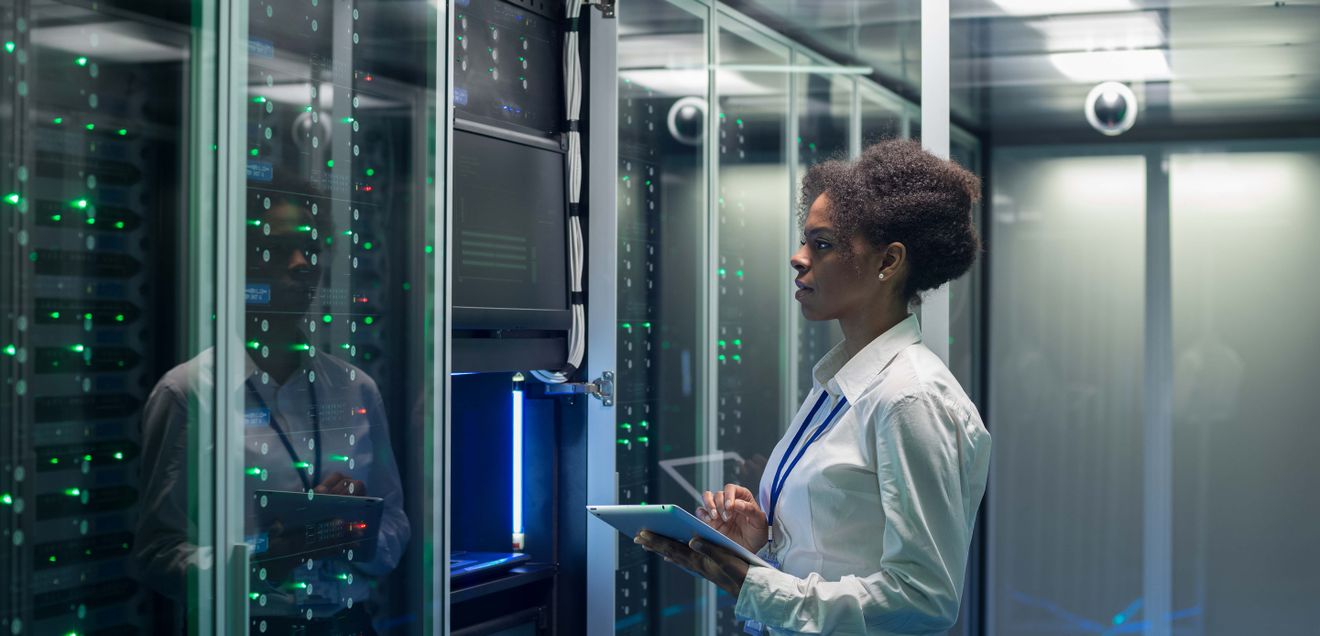
Together, these competencies create flexibility across computing power, energy and infrastructure systems, helping data center operators connect to the grid faster, scale efficiently and operate reliably in a world with limited energy resources.
"Scaling AI infrastructure is not just a question of computing power, but equally a challenge in the context of energy and infrastructure," says Ruth Gratzke, President of Siemens Smart Infrastructure U.S. "With the growing demand for AI computing power, data center growth is increasingly constrained by limited grid capacity and long grid connection times. Overcoming this obstacle requires close and complex coordination between digital infrastructure and the energy sector. Siemens is actively investing in key technologies and partnerships to expand the ecosystem needed to responsibly scale AI and enable future-ready data center infrastructures."
Emerald AI enables AI workloads to be shifted in time and location to adapt to grid conditions, allowing data center demand to dynamically respond to available power supply. By coordinating when and where AI workloads are run, combined with the use of locally available energy resources, this approach helps to balance peak loads, realize faster and larger grid connections for data centers and reduce the strain on limited energy infrastructure. The strategic investment in Emerald AI strengthens Siemens' ability to create flexibility at the computing level. Together with Siemens' expertise in energy infrastructure and operational technology, this enables true IT/OT convergence between AI workloads and energy systems.
A key component of this expanded ecosystem is the integration of Fluence's grid-scalable energy storage solutions, specifically designed to support future high-performance AI data centers. As data clusters continue to grow in size and power density, Fluence's energy storage solutions enable data centers to accelerate their grid connectivity. They do this by optimizing load profiles and coordinating startup and shutdown speeds. This makes the energy requirements of AI more predictable and easier for energy suppliers to approve. In this way, even locations with limited power supply can become suitable data center locations and the time to power can be accelerated. Energy storage systems can therefore be deployed within months instead of years of grid expansion. In addition, Fluence's energy storage solutions can provide controllable, on-site power, allowing data centers to operate during grid expansion phases, capacity constraints or power outages. By ensuring consistent power quality and flexible scalability, Fluence helps data center operators bring new capacity online faster while maintaining the reliability required for mission-critical AI workloads.
To further strengthen this ecosystem, Siemens is working with PhysicsX to apply physics-based AI to the design and operation of power distribution systems in data centers. Using AI models trained on Siemens' multi-physics simulation data, engineers can predict the thermal behavior of complex busbar systems in real time. Thanks to PhysicsX, simulations that used to take several days can now be performed in less than a second. This enables faster design iterations, an optimized infrastructure for dynamic AI workloads and the basis for predictive monitoring of entire plants.
The rapid growth of AI will continue to place new and often highly dynamic demands on power grids. Large training and inference clusters generate rapidly changing loads that increasingly challenge traditional grid planning and data center design. As a result, operators must find new ways to manage these demands while ensuring the performance and reliability required for AI infrastructure. Siemens' expanded ecosystem is designed to address this challenge by unifying the orchestration of AI workloads, grid-integrated power systems and AI-optimized physical infrastructure to support the future AI infrastructure.


You might also be interested in
Strike at the start of the Hannover Messe
On the occasion of the strike announced by ver.di on the first two days of Hannover Messe 2026 (20 and 21 April), which will paralyze public transport in Hanover, the organizer, Deutsche Messe, is expressing clear criticism and great concern about...
 read more...
Automated wiring: how to build efficient control cabinets
Pressure and complexity are increasing in enclosure manufacturing. Automated wire assembly, digital production control and smart wire logistics from Rittal Automation Systems and Eplan reduce the workload on skilled workers, increase quality and...
read more...Rollout of more than 100 AI-controlled Robot Systems planned
Syncore (formerly known as Reesink Logistic Solutions) and Stuttgart-based AI robotics company Sereact are deepening their partnership. At Logimat, the companies signed a letter of intent to expand their partnership with the aim of introducing more...
read more...New Solutions for Physical AI
NXP Semiconductors has introduced innovative robotics solutions for reliable, secure real-time data processing and transmission as well as advanced networking. These enable sensor fusion, machine vision and precise motor control.
read more...Agentic AI as a Basis for Success for Start-ups
January 2026 started with a record for startups, with almost a third more startups being founded in Germany. A new high was reached with 3568 newly created companies, as announced by the Startup Association - also thanks to AI. Nico Gaviola, VP...
read more...Siemens makes a strong Start to Fiscal Year 2026
Siemens raises its forecast for 2026 after a strong first quarter. Order intake and sales increased significantly, industrial earnings rose at a double-digit rate. The order backlog reached an all-time high of 120 billion euros.
read more...Camera for simplified AI-based Quality Controls
Omron's 'FHV7-AI' detection camera joins the company's family of industrial FH vision vision systems. The new model combines AI-powered inspection capabilities with a simplified user interface and a compact all-in-one design.
read more...AI-based Measurement technology
Siemens takes over Canopus AI
Siemens has announced the acquisition of Canopus AI. The company is a provider of computational and AI-powered metrology solutions that enable semiconductor manufacturers to achieve new levels of precision and efficiency in wafer and mask inspection...
read more...Education and the Labor Market
IBM calls for AI Projects Worldwide
IBM launches a global tender for AI solutions in education and labor market integration. Non-profit organizations and universities can apply until the end of March 2026.
read more...